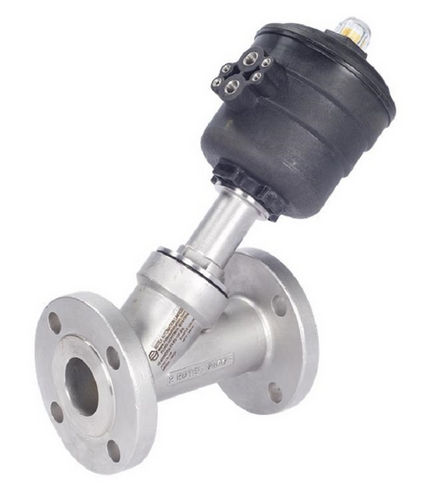
About 2 WAY FLANGED END ANGLE SEAT VALVES
Pressure Range(Bar): Normally Close -Above Plug : 0-25 | Below plug : 0-25Normally Open : 0-25Universal - Above plug : 0-25 | Below plug : 0-16Orifice Size (mm): 12Port Connection: 1/2" to 3 inchMOC: CF8 (SS304 Cast) | CF3M (SS316L Cast)Solenoid: Weather Proof | Expl osion Proof | Intrinsically safeMedia:Liquid | Gas | Steam | LPG | Water | Oil | FuelApplication: Medical Sterilizers | Auto claves | Foods & Beverages - Boiler Steam control | Water treatment plant | Textile Dyeing & Drying | Bottling & Dispensing equipment | Ink & Paint Dispensing | Laundry EquiCertificate: ATEX | CCOE/PESO | CUTR-EAC | IEC Ex | INMETRO | UKRAINE | CE | ULSuperior Material and ConstructionManufactured from corrosion-resistant stainless steel, these angle seat valves guarantee high durability even in challenging industrial conditions. The flanged ends facilitate secure and leak-proof installation, while the robust structure ensures long operational life with minimal maintenance requirements.
Wide Application SuitabilityWhether in medical sterilization units, food and beverage steam management, water treatment, or industrial dispensing equipment, our angle seat valves provide precise fluid and steam control. The broad range of port sizes and temperature tolerance make them highly adaptable across multiple industries.
Efficient Pneumatic OperationDesigned for pneumatic control, these valves offer rapid response and accurate flow regulation. This pneumatic actuation enhances overall process efficiency, reduces manual intervention, and supports automated system integration for modern industrial workflows.
FAQ's of 2 WAY FLANGED END ANGLE SEAT VALVES:
Q: How are 2 WAY FLANGED END ANGLE SEAT VALVES typically installed?
A: These valves are installed using the flanged end connections, ensuring a secure and leak-resistant fit with piping systems. Proper alignment and torque application are necessary to maintain long-term integrity and optimal operation.
Q: What benefits do stainless steel angle seat valves provide in medical sterilizers and food processing?
A: Stainless steel offers exceptional corrosion resistance and hygiene, essential for medical and food industries. The robust construction withstands high temperatures and steam, ensuring reliable, contaminant-free operation.
Q: When should you use a pneumatic valve over a manually operated valve in industrial systems?
A: Pneumatic valves are recommended when frequent, rapid, or remote actuation is needed. They are especially advantageous in automated processes, such as in bottling lines or sterilization chambers, where consistent and precise control is critical.
Q: Where can these valves be utilized besides water and steam systems?
A: Besides water and steam, these valves are suitable for applications in textile dyeing and drying, ink and paint dispensing, and industrial laundry equipment-anywhere robust, high-temperature fluid control is needed.
Q: What is the process for maintaining these angle seat valves?
A: Routine maintenance involves inspecting seals for signs of wear, checking pneumatic actuators for proper function, and ensuring flanged connections remain tight. Scheduled servicing maximizes valve performance and lifespan.
Q: How does the valve's angle seat structure benefit industrial flow control?
A: The angle seat design offers low flow resistance and rapid opening/closing, which enhances efficiency and allows precise regulation of high-temperature fluids. This structure is invaluable for applications requiring quick response times and high throughput.





 Send Inquiry
 Get Latest Price

